
Pain can be scary.
Especially when the trigger doesn’t seem to have been caused by anything over the top.
You just bent down to pick something up, or put your socks on, and it hits – severe back spasm – a deep intense cramp like sensation.
It can stop you moving normally, make you avoid exercise, change the way you walk, and leave you wondering whether something serious is going on.
This is especially common with lower back pain and sciatica.
Most of us naturally think:
“If it hurts, it must be damaged.”
That makes sense. Pain often happens after an injury. If you strain your back, roll your ankle, or irritate a nerve, pain is usually part of the experience.
But pain isn’t always as simple as a damage signal.
Pain is real. It matters. But it doesn’t always tell us exactly how much damage is present.
A better way to think about pain is as your body’s protection system. Its job is to get your attention and help keep you safe. Restrict your movement so you don’t do damage.
Strain is sensed, so our protective mechanism kicks into gear to immobilise.
Sometimes that protection is very useful.
Much like an airbag in a car is set off in a collision to protect us in an accident.
Sometimes, especially with persistent, recurrent, or chronic pain, that protection system can become too sensitive.
At PhysioCentral, we use this understanding to help people feel calmer, move with more confidence, and gradually get back to doing more.
On this page
- Pain is useful, especially after a new injury
- When pain becomes too sensitive
- Sensitive pain response or injury?
- Back pain is a good example
- What about sciatica?
- Pain is like an alarm system
- Why do I feel so tight or guarded?
- Why movement matters
- Our first job is to check safety
- How we usually build rehab
- What about flare-ups?
- How much pain is okay during exercise?
- Progress is more than pain relief
- When should you seek medical review?
- Need help with pain or movement?
Pain is useful, especially after a new injury
Pain is not the enemy.
Pain is one of the body’s most useful protective systems.
If you strain your back, cut your finger, roll your ankle, or injure a muscle, pain makes you aware of it, and helps you look after the area. It makes you slow down, move carefully, and avoid doing too much too soon.
That’s a good thing.
In the early stages of a new injury, the body often needs time and care. The area may be inflamed, swollen, painful, weak, and not ready for heavy loading.
This is why early rehab isn’t about pushing through everything.
It’s about doing the right thing at the right time.
At PhysioCentral, we often explain recovery through a simple sequence:
1. Mobility
2. Flexibility
3. Strength
That sequence matters because the body needs to be ready for each stage.
Trying to strengthen too early, when the body is still guarded, painful, and stiff, will stir things up.
So we usually start by helping the body move better first.
When pain becomes too sensitive
Where things become more confusing is when pain keeps hanging around.
This is common with:
- persistent lower back pain
- recurrent episodes of back spasm
- ongoing neck pain or headache
- repeated flare-ups
- some sciatica-type symptoms
- pain that keeps returning without much warning
In these cases, pain may still be real and very unpleasant, but it may no longer be a simple sign of fresh tissue damage.
Instead, the body’s protective system can become too sensitive.
The back may tighten quickly.
Movement may feel blocked.
The muscles may guard.
A small movement may cause a big pain response.
A flare-up may feel like you’ve gone back to square one.
But that doesn’t always mean you’ve damaged yourself again.
Often, it means the system has become very good at protecting you. A bit too good. It’s on high alert. Always on the lookout for any strain. Hypervigilant.
It’s trying to protect something very important.
You!
A helpful way to think about this is that pain can change over time.
Early after an injury, pain is often more closely linked with tissue healing. But when pain keeps hanging around or keeps coming back, the nervous system can become a bigger part of the picture.
That doesn’t mean the pain isn’t real. It means the driver of the pain may have changed.
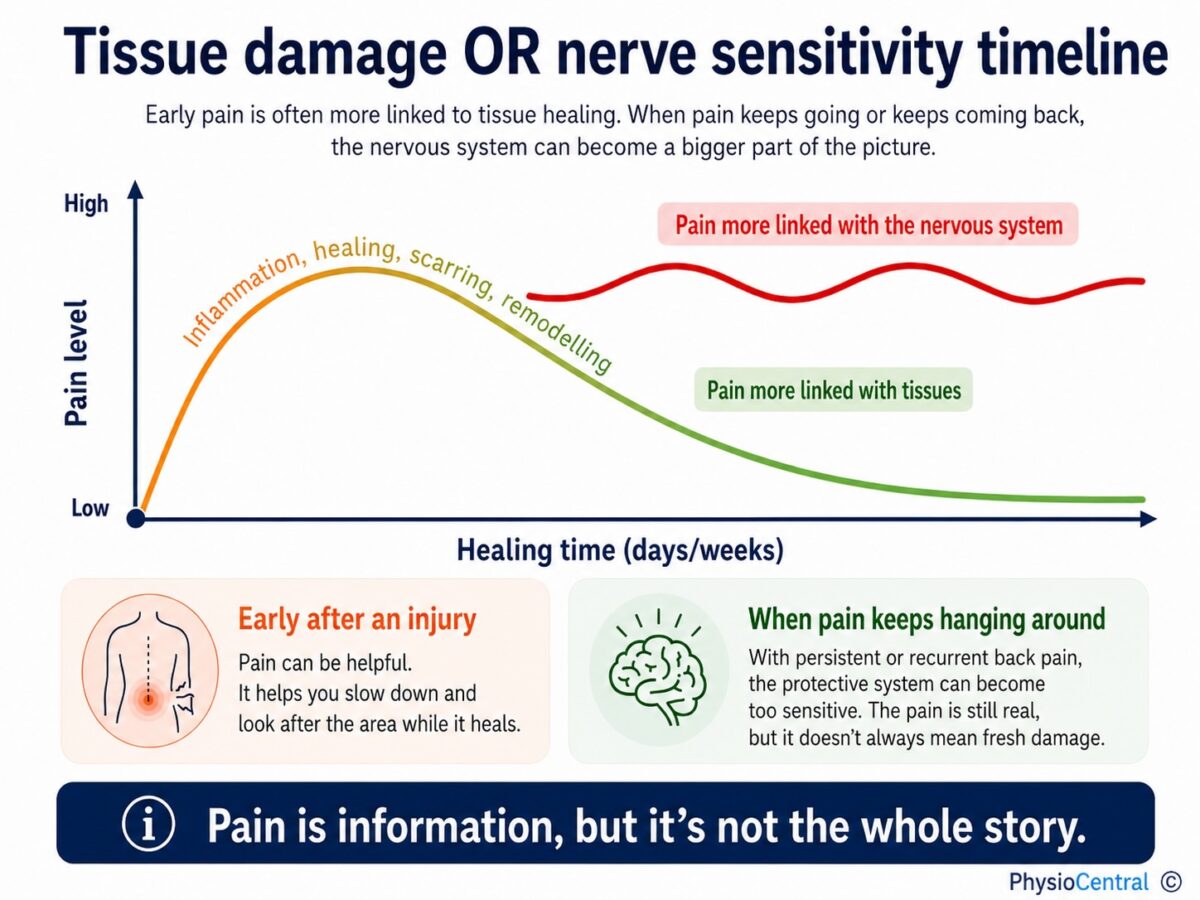
This is why ongoing or recurrent back pain doesn’t always mean a new injury or repeated damage. It simply means the protective system is still overly sensitive, and over reactive.
Sensitive pain response or injury?
A helpful way to think about pain is to ask:
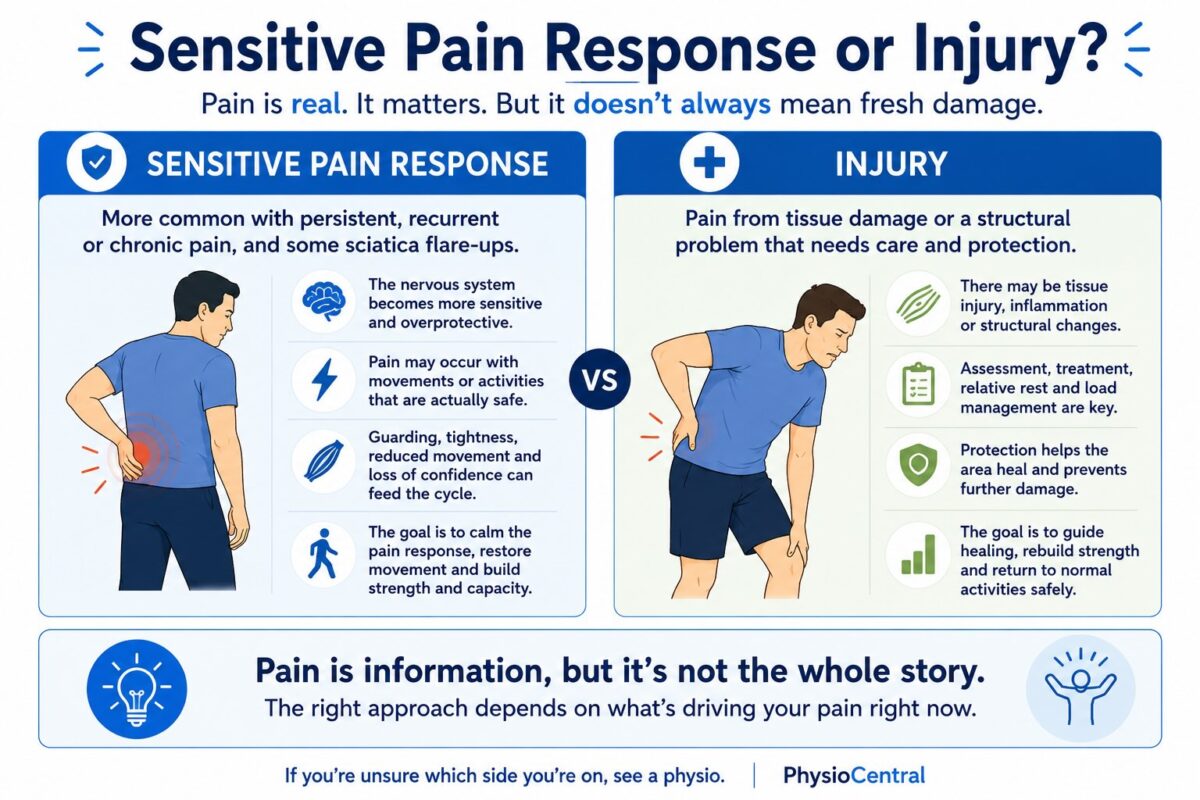
“Is this mainly a sensitive pain response, or is this an injury that needs looking after?”
Sometimes it’s both.
A new injury usually needs care. It may need assessment, treatment, relative rest, and a careful plan while the tissue heals.
But persistent, recurrent, or chronic pain can behave differently.
With recurrent back pain or some sciatica flare-ups, pain may be driven more by sensitivity, guarding, reduced movement, loss of strength, fear of movement, or an overprotective nervous system.
That’s why two people can both have back pain but need slightly different treatment plans.
One person may need more focus on tissue healing.
Another person may need help calming the pain response, restoring mobility, improving flexibility, and gradually rebuilding strength.
Pain is information, but it’s not the whole story.
Back pain is a good example
Let’s use lower back pain as an example.
Someone with a fresh back strain may need a short period of relative rest, pain relief, gentle movement, and careful load management.
That’s normal.
But someone with recurrent lower back pain may have a different problem.
Their back may have learned to guard quickly. The muscles may tighten as soon as the body feels threatened. Bending, sitting, lifting, walking, or getting out of bed may all feel risky.
In that situation, the pain is still real.
But it’s more about sensitivity and protection than fresh damage.
That’s why treatment needs to do more than simply chase the sore spot.
We need to calm the pain response, restore mobility, improve flexibility, and gradually rebuild strength so the back can tolerate normal life again.
You can learn more on our back pain and sciatica page.
What about sciatica?
Sciatica can feel especially worrying because symptoms can travel into the buttock, thigh, calf, or foot.
Sometimes it can feel sharp, burning, electric, shooting, or intense.
That deserves proper assessment.
We want to know whether the nerve is simply irritated and sensitive, or whether there are signs of more serious nerve compromise.
Important things we look for include:
- worsening weakness
- increasing numbness
- changes with bladder or bowel control
- numbness around the saddle area
- symptoms that are rapidly worsening
If any of these are present, medical review may be needed.
But not all sciatica means serious nerve damage.
Sometimes the nerve is irritated, inflamed, or sensitive. It can be very painful, but still improve with the right plan.
If there are no signs of anything serious, the aim is usually to calm the system down, restore movement, improve nerve and spinal mobility where appropriate, and gradually rebuild tolerance.
Again, the aim isn’t to ignore the pain.
The aim is to understand what type of pain response we’re dealing with and choose the right starting point.
Pain is like an alarm system
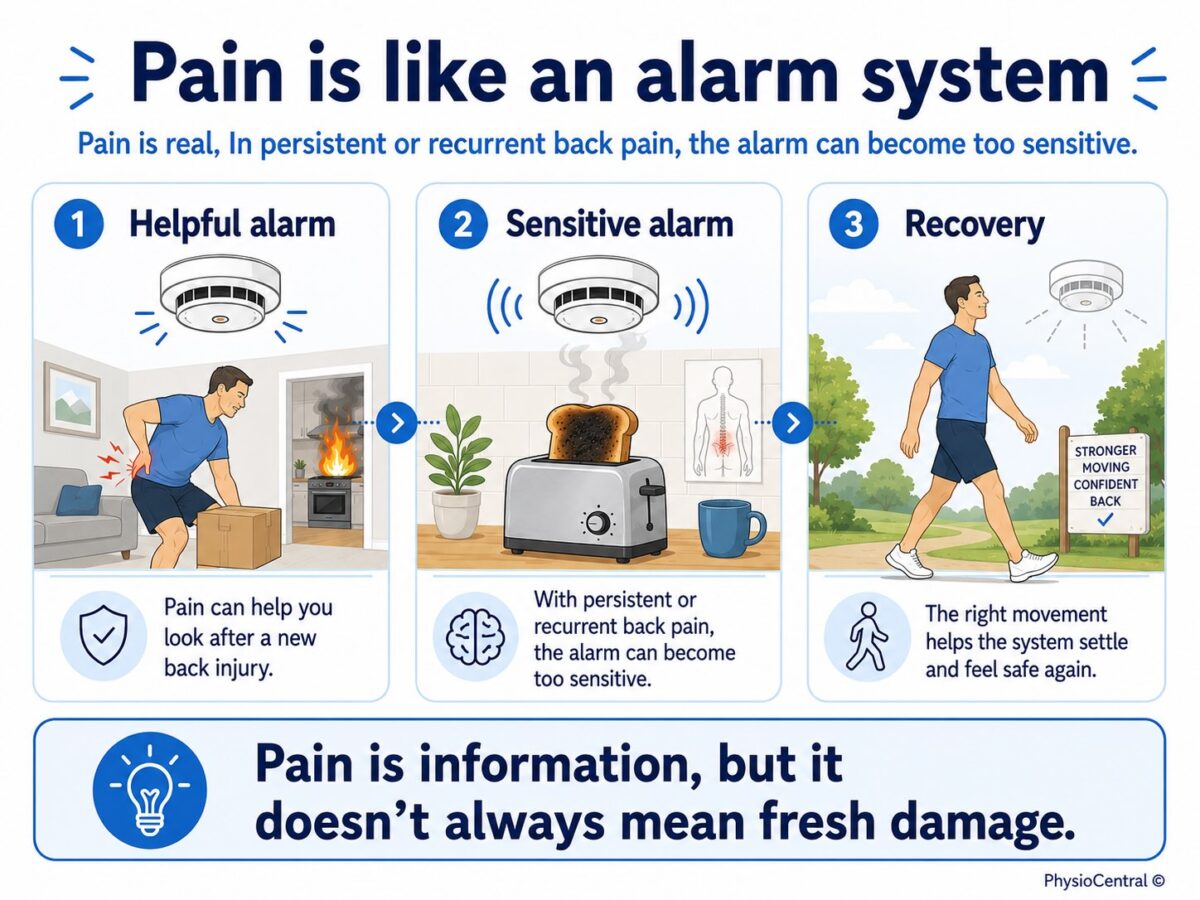
After a new back injury, that alarm can be useful. It warns you to slow down, move carefully, and look after the area while it settles.
But with persistent or recurrent back pain, the alarm can become too sensitive.
It may go off loudly with movements that feel threatening, even when there’s no fresh damage.
That doesn’t mean the pain is imaginary.
It means your nervous system may be working hard to protect you.
Sometimes a bit too hard.
Why do I feel so tight or guarded?
Tightness is one of the most common things people feel with back pain.
It can feel like the back is locked, stuck, blocked, or about to go into spasm.
Sometimes tightness is part of tissue healing. In a fresh injury, the body can tighten around the area while repair begins.
It can also tighten if you’ve been doing the right thing and strengthening it. All muscles tighten as a precursor to strength increases.
If the areas hypersensitive, however, it will over tighten – that’s another reason why we need a carefully designed and gradually progressing treatment and rehab plan.
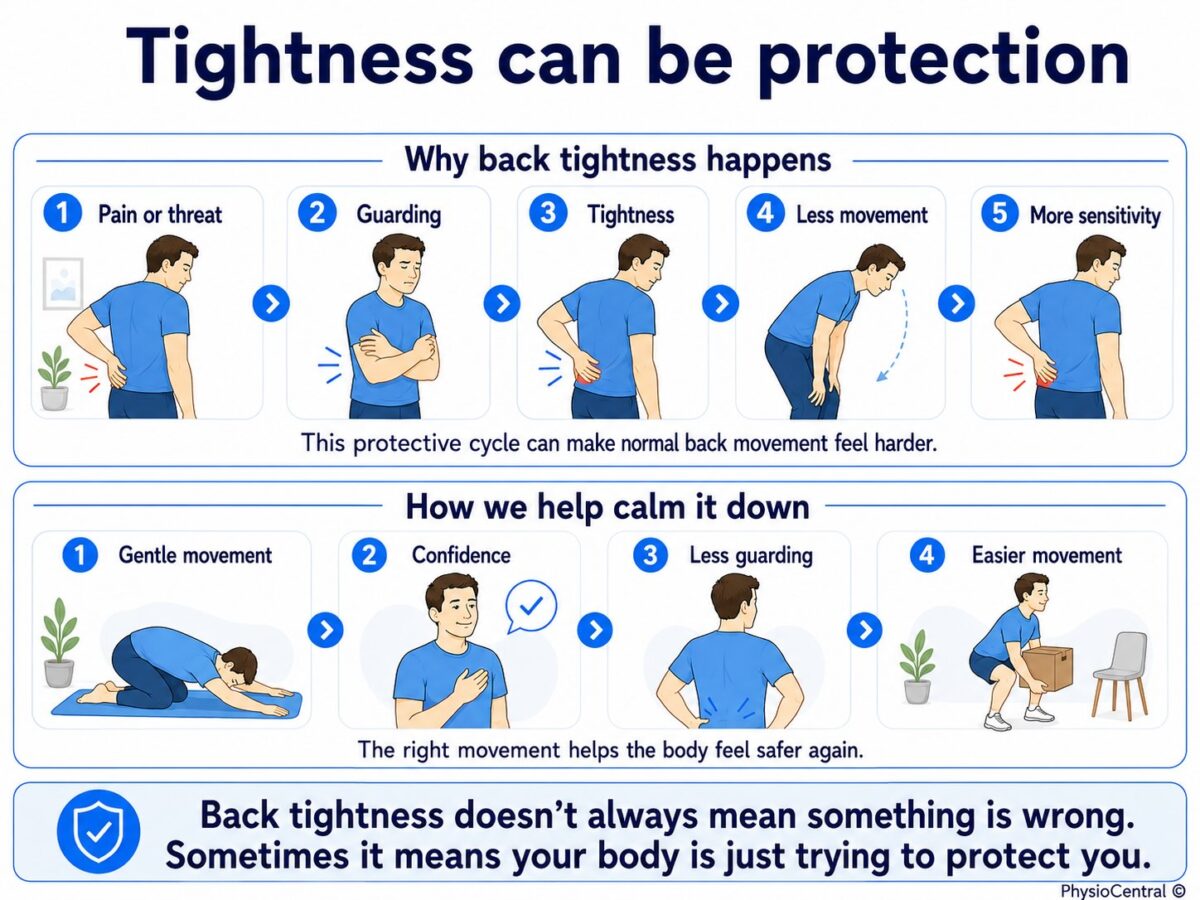
In persistent or recurrent back pain, tightness can also be part of an overprotective cycle.
Pain or threat can lead to guarding.
Guarding can lead to tightness.
Tightness can lead to less movement.
Less movement can lead to more sensitivity.
More sensitivity can lead to more pain.
That cycle can make normal movement feel harder than it should.
The way out is usually not to force it.
The way out is to start with the right level of mobility, then flexibility, then strength.
Why movement matters
Movement is often the first step.
Not aggressive movement.
Not heavy strengthening straight away.
Not pushing through sharp pain.
Just the right amount of movement at the right time.
For back pain, that might start with simple mobility exercises, walking, gentle spinal movement, or positions that help the back feel less guarded.
For sciatica, it may involve finding movements that settle the nerve irritation rather than stirring it up.
Once movement becomes easier, we can work on flexibility.
Once flexibility improves, we can build strength.
That’s the PhysioCentral sequence:
Mobility → Flexibility → Strength
Trying to strengthen too early, when the body is still guarded and stiff, will make the tight bits tighter. Generating more protective spasm and pain.
Our first job is to check safety
Before we ask you to move more, our first job is to check whether there are signs that something more serious may be going on.
This may include questions about:
- how your pain started
- your symptoms
- your medical history
- previous injuries
- scans or tests
- strength
- sensation
- movement
- what makes your pain better or worse
If we see anything that needs medical review, or imaging, we’ll tell you.
If we don’t see signs of anything dangerous, then we can start helping you move forward safely.
You might hear your physio say something like:
“I know you’re in pain, but it doesn’t appear to be anything dangerous, or over concerning. We’ll get to work on settling it down, and then getting you back on track.”
That’s not the same as ignoring pain.
It means we’ll respect the pain, while also helping your body regain confidence.
You can learn more about how we assess and treat movement problems on our physiotherapy services page.
How we usually build rehab
Developed by Graeme Curran, at PhysioCentral, we explain rehab in three stages.
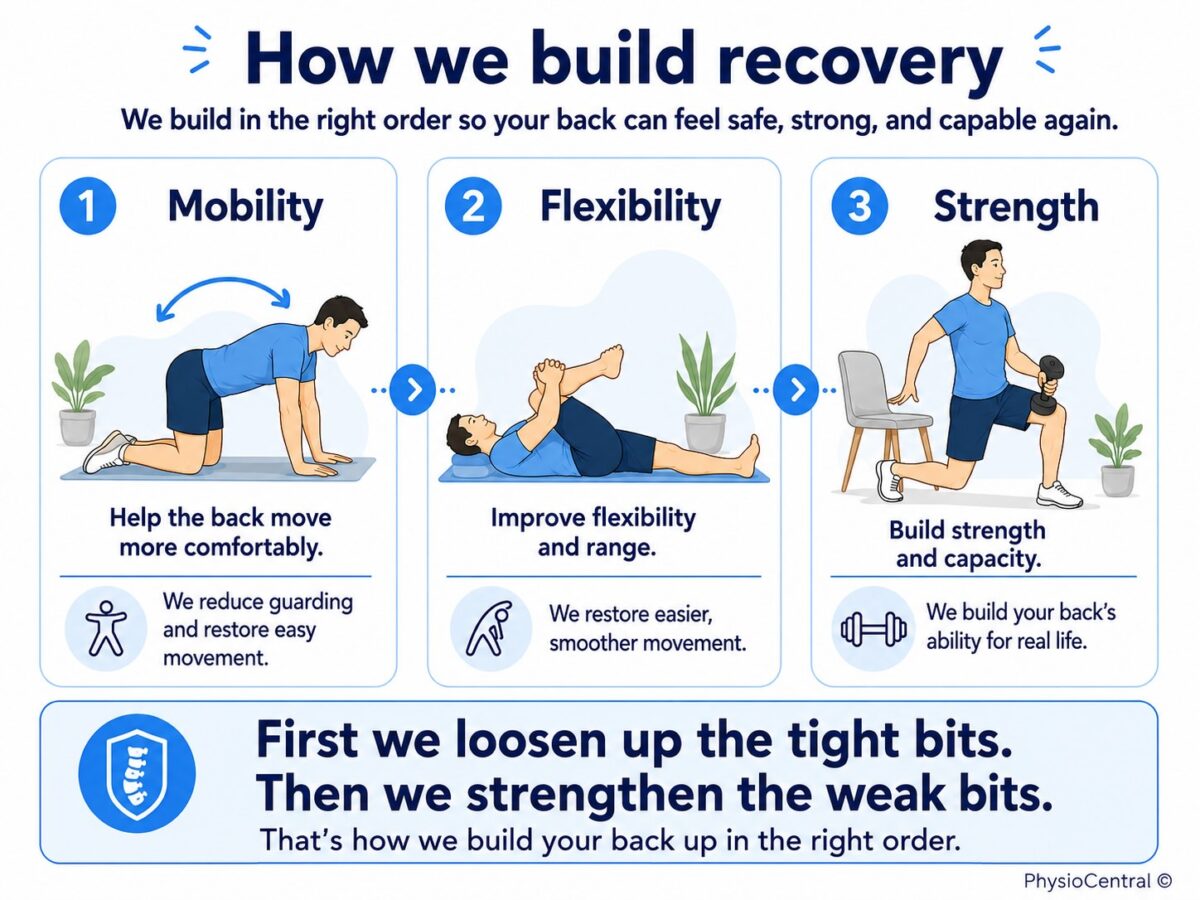
1. Mobility
First, we help the area move more comfortably.
Pain often causes guarding, and guarding can make normal movement feel harder. Gentle mobility work helps reduce that protective response and shows your body that movement can be safe.
The goal isn’t to force anything.
The goal is to find a safe starting point.
2. Flexibility
Next, we work on improving range and reducing that restricted feeling.
As movement becomes more comfortable, flexibility work can help restore easier, smoother movement for daily activities.
3. Strength
Then we build strength and capacity.
This helps your body handle real life again, including:
- walking
- bending
- lifting
- stairs
- work tasks
- sport
- gym training
- household jobs
- playing with kids or grandkids
Strength is important, but timing matters. If the system is highly guarded and sensitive, jumping into hard strengthening too early can stir things up.
What about flare-ups?
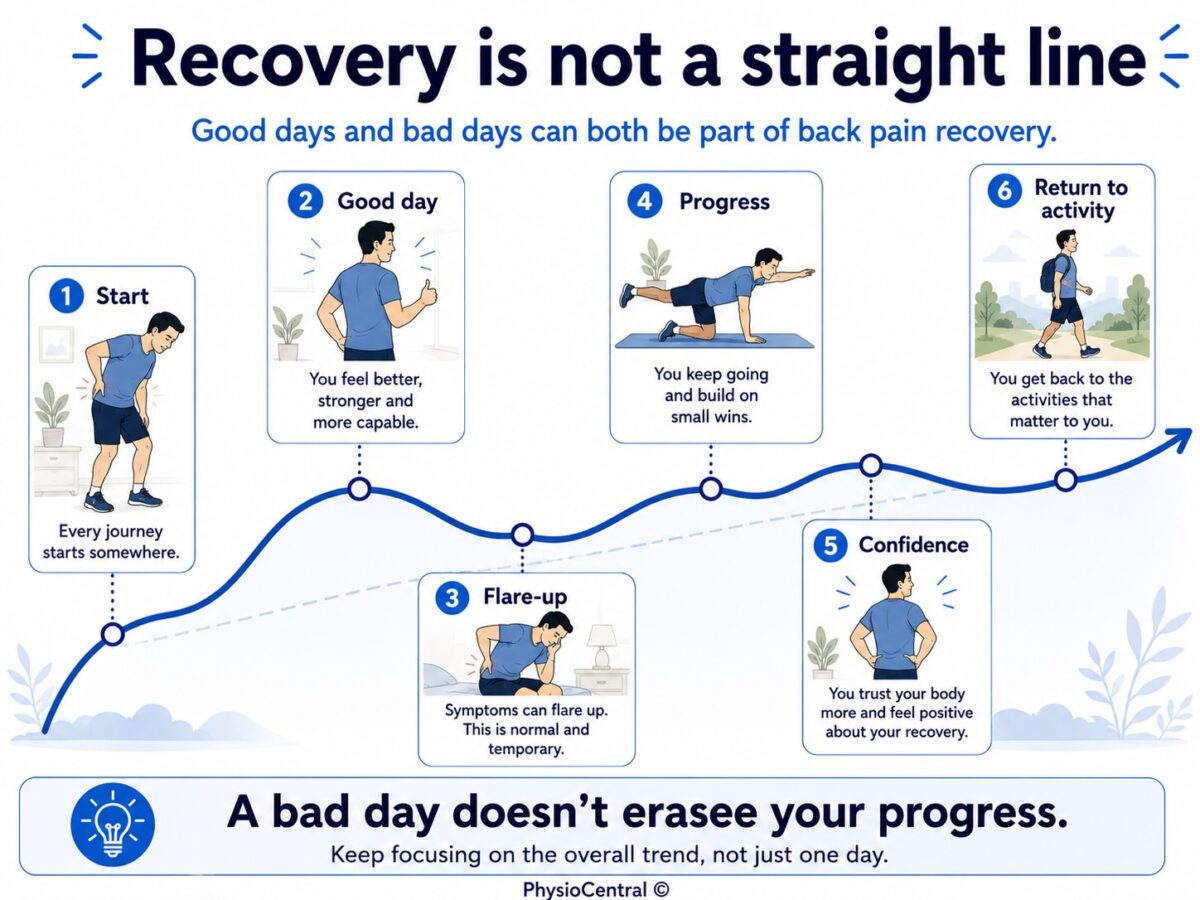
Recovery is rarely a perfectly straight line.
This is especially true with persistent or recurrent back pain and sciatica.
You may have a few good days, then a flare-up.
That can be frustrating, but it doesn’t automatically mean you’ve damaged yourself again.
A flare-up often means the current dose was a bit too much for where your system is right now.
Maybe you walked further.
Maybe you sat too long.
Maybe you lifted more than usual.
Maybe stress, poor sleep, or a busy week lowered your tolerance.
The key is to look at the overall trend.
Are flare-ups becoming less intense?
Are they settling faster?
Are you doing more before symptoms build?
Are you recovering better afterwards?
If the overall trend is improving, you’re still moving in the right direction.
How much pain is okay during exercise?
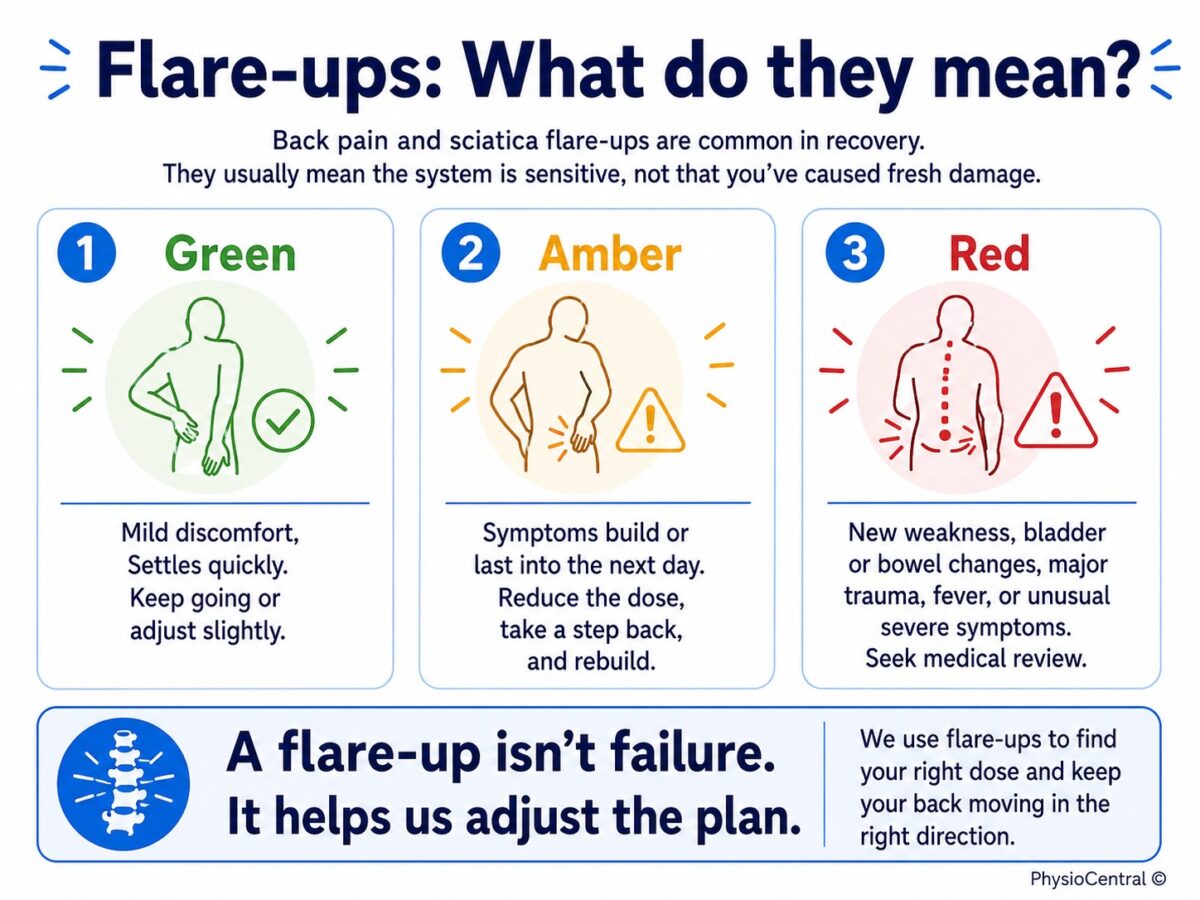
This depends on the person and the condition, but as a general guide, a small amount of discomfort can be okay if:
- it feels manageable
- it doesn’t keep building
- your movement still feels controlled
- it settles afterwards
- you’re not worse later or the next day
Pain that is sharp, severe, escalating, unusual, or leaves you much worse afterwards needs to be reviewed.
We don’t want you ignoring pain.
We want you learning how to interpret it.
Pain is information. It helps us adjust the plan.
A simple way to think about it is:
🙂 Usually okay
- mild discomfort: 2-3/10 pain
- settles quickly
- movement still feels controlled
- no major flare later or the next day
🙁 Needs adjustment
- symptoms keep building. 4-6/10 pain
- movement becomes very guarded
- pain lasts into the next day
- you feel much worse afterwards
😩 Needs review (back pain example)
- new weakness
- numbness that’s worsening
- bladder or bowel changes
- major trauma
- fever or feeling very unwell
- severe, unusual, or escalating symptoms. 7-10/10 pain
Progress is more than pain relief
Of course, pain relief matters.
But pain isn’t the only sign of progress.
Good signs can include:
- moving more freely
- walking further
- sitting or standing longer
- sleeping better
- using less medication
- feeling less worried
- doing more normal activities
- recovering faster after flare-ups
- trusting your body more
- getting back to work, sport, or hobbies
Sometimes confidence and function improve before pain fully settles.
That still counts as real progress.
Red Flags: When should you seek urgent attention?
Most musculoskeletal pain isn’t dangerous, but some symptoms need medical attention.
Please seek urgent medical review if you develop:
- new or worsening weakness
- changes with bladder or bowel control
- numbness around the saddle area
- major trauma
- fever or feeling very unwell
- unexplained weight loss
- severe night pain that doesn’t change with position
- sudden severe headache unlike your usual headache
- difficulty speaking, swallowing, walking, or new facial drooping
If you’re unsure, ask your physio or GP.
It’s always better to check.
Related PhysioCentral pages
Pain can affect many different areas of the body, and the right explanation and rehab plan can make a big difference.
You may also like to read about:
- Back pain and sciatica
- Neck pain and headaches
- Shoulder pain
- Knee pain
- Ankle and foot pain
- Wrist and hand pain
- TMJ jaw pain
- Vertigo, dizziness and balance disorders
- Physiotherapy services in Miranda and the Sutherland Shire
Need help with pain or movement?
If pain is stopping you from moving normally, our physiotherapists can help you understand what’s going on, check whether there are signs of anything serious, and create a clear plan to help you move with more confidence.
At PhysioCentral, we’ll help you find the right starting point, then build from there.
Whether you’re dealing with back pain, sciatica, neck pain, headaches, shoulder pain, knee pain, an ankle injury, or pain that’s been hanging around for a while, we’ll work with you to make sense of it and help you get moving again.
Click the ‘Book Online Now’ button above, to come in and see one of our awesome Physios!
Or
Learn more about our physiotherapy services in Miranda and the Sutherland Shire.
The main message
Your pain is real.
Your body is trying to protect you.
Pain doesn’t always mean fresh damage, especially when pain has become persistent, recurrent, or overprotective.
Once we know you’re safe, the right movement can help your body calm down, rebuild confidence, and get stronger.
The goal isn’t to ignore pain.
The goal is to understand it, respect it, and help you get back to doing more.
References and further reading
This article draws on contemporary pain science, patient education resources, and PhysioCentral’s clinical approach to a 3 phase recovery.
- Moen D, Foster F. Permission to Move: A simple guide to help clinicians use pain science in everyday practice. Permission to Move Pty Ltd, 2019.
- Butler DS, Moseley GL. Explain Pain. Noigroup Publications.
- Psychwire. Contemporary Pain Education Q&A with Lorimer Moseley.
https://psychwire.com/free-resources/q-and-a/1mb9l2b/contemporary-pain-education - Tame the Beast. Pain education resource developed with Lorimer Moseley and colleagues.
https://www.tamethebeast.org/ - International Association for the Study of Pain. IASP Terminology and definition of pain.
https://www.iasp-pain.org/resources/terminology/ - International Association for the Study of Pain. What is pain?
https://www.iasp-pain.org/publications/relief-news/article/what-is-pain/ - PainHEALTH. Low back pain.
https://painhealth.com.au/pain-module/low-back-pain/ - Painaustralia. What is pain?
https://www.painaustralia.org.au/about-pain/what-is-pain - healthdirect Australia. Chronic pain.
https://www.healthdirect.gov.au/chronic-pain - Jean Hailes. Learn about pain.
https://www.jeanhailes.org.au/look-after-yourself/learn-about-pain/ - Australian Commission on Safety and Quality in Health Care. Low Back Pain Clinical Care Standard.
https://www.safetyandquality.gov.au/clinical-care-standards/low-back-pain - UHCW NHS. Sciatica self-care advice.
https://www.uhcw.nhs.uk/self-care/sciatica/ - Musculoskeletal Matters Dorset NHS. Back pain, leg pain, and sciatica.
https://www.mskdorset.nhs.uk/back-pain_1/back-pain-leg-pain-sciatica/